
The Human Touch: What MAD//Fest 2026 Taught Us About Marketing in the Age of AI
Every year, MAD//Fest gives the industry a theme to argue with itself about. This year it was “The Human Touch” — a direct response to a moment when AI-generated content has become so ubiquitous that “AI slop” was named Macquarie Dictionary’s Word of the Year. Co-founder Dan Brain framed the festival around the evolving relationship between AI, creativity, human connection, and effectiveness, and the question hanging over the Truman Brewery all week was whether brands can have their cake and eat it: use AI for efficiency without sacrificing the creativity that actually builds distinctive brands.
Having sat through talks from Cornetto to Center Parcs, a handful of threads kept resurfacing.
AI gives time back — it doesn’t do the work of taste
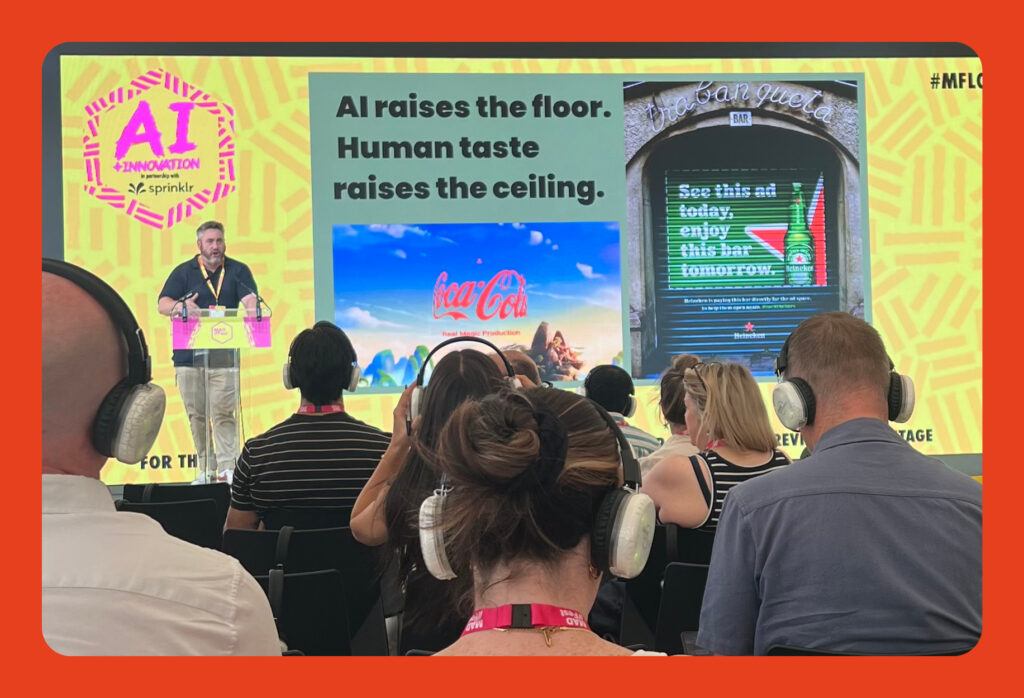
The most consistent message wasn’t “resist AI,” it was “don’t let AI make the decisions that matter.” Mike Pearson (Wayfair) put it best: AI isn’t stealing creativity, it’s giving marketers time back, and the real skill is what you do with that time — better briefs, better judgement, better taste, better people. Karen Wilkinson (Evergreen Garden Care) put it more bluntly: brand growth has to stay human-judgement-led. Melissa Goffe (Müller) warned against getting seduced by AI’s efficiency, because “good enough” doesn’t cut it anymore — it just raises the bar for everyone chasing average.
Uber’s Will Hooker explained the mechanics of why: AI can help you find the formula, but it can’t find the answer. AI predicts based on what’s already happened; the stories that actually change behaviour tend to be the ones that don’t quite make sense yet — which a prediction engine can’t generate.
Creative risk still requires a human willing to take it
A few speakers put data itself in the dock. Katie Evans (Burger King) argued that when data has too much power, it kills creativity — “creativity is beautifully irrational” was her call to arms for teams tempted to A/B test their way to safety. Valentina Ciobanu (General Mills) offered the practical version: hold your nerve even when a decision isn’t “AI-approved,” because average is what happens when nobody has to.
Suzuki’s Jodie Taylor gave the clearest live demo of this. Her team asked AI to generate a car ad — technically competent, entirely uninteresting, full of category clichés. So they built the opposite: a campaign rooted in one unique truth about the brand (“Good Different”) that no model would generate, because it wasn’t already in the training data.
Empathy and lived experience are the actual moat
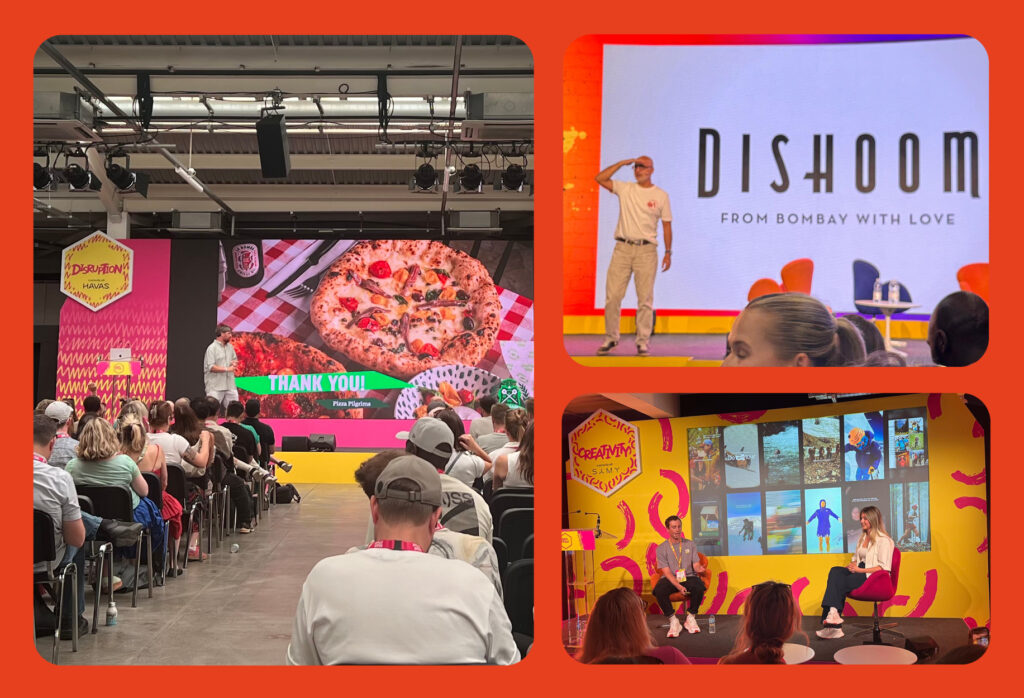
Several talks located distinctiveness not in a clever execution but in a genuinely understood human problem. Sophie Giddings (Little Dish) showed how design became a growth lever by solving parents’ lack of time, building the brand around being a “mealtime ally.” Shamil Thakrar told Dishoom’s story through poetry, tracing a brand built on the Irani cafés of Bombay — difference and diversity woven into everything down to the “Meal for a Meal” initiative, which has now delivered 35 million free meals. Thom Elliot (Pizza Pilgrims) made the same point from a founder’s chair: community — the pilgrimages to Naples, the people, the authenticity — is the one part of the business you can’t automate.
Myrthe Mertens De Vry’s North Face case was a useful counterpoint on creator content: brands too often hand their identity over to creators and disappear into the noise. ‘It’s Never Just a Hike’ worked because the brand voice stayed intact while still reaching new audiences through creators.
Culture and permission matter as much as tools
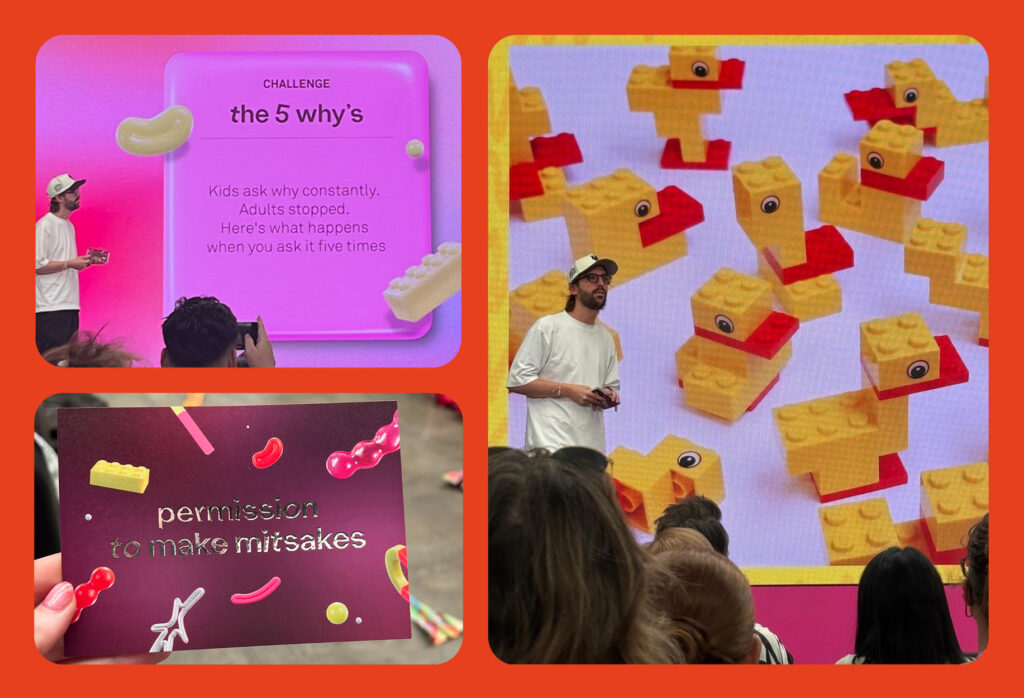
Rachael Pettit and Sam Fletcher’s Lloyds talk was less about output and more about the conditions that make good output possible: celebrate experiments, crowdsource ideas, give every experiment a clear purpose. Jonathan Wicks and Eva Cremers (LEGO) made a similar argument through play — literally building LEGO ducks to make the point that resisting the urge to critique an idea before it’s had room to breathe is what lets surprising answers surface.
Jen McAleer’s Lloyds session tied this to a bigger shift: brands can no longer assume their size or heritage commands trust automatically. Trust has to be earned through relevance — the institutional version of the same argument Little Dish and Dishoom were making at product level.
Technology’s best role is removing friction, not replacing connection
Where AI and data got genuine praise, it was almost always in a supporting role. Nuala Gallagher (Greene King) talked about pubs as the original social network, where technology’s job is to strip out daily admin so staff can focus on the actual human interaction. Sarah Barron (Domino’s) showed the flip side — a data business (half of UK households have a Domino’s account) using that data to unlock creative opportunities rather than replace them. Alex Knapman (Halfords) argued retail media should optimise for genuine usefulness — a “how to fit a car seat” video — over clicks, precisely because AI makes it trivially easy to flood every channel with content nobody needed.
The commercial case for human connection
This wasn’t just sentiment — several speakers backed it with hard numbers. Sara Holt’s Center Parcs case was the standout: 80 consecutive periods of growth (barring Covid), a record 97.8% occupancy rate, and record EBITDA, all attributed to doubling down on human connection, now being extended through the “For the Center of Your World” platform. Domino’s data-led creativity delivered similarly strong commercial results. And Rory Sutherland and Tom Ridges rounded out the last day of the festival with a provocation that ties it all together: herd mentality and social proof drive real commercial value, but it’s a kind of value that’s genuinely hard to capture on a balance sheet — which may be exactly why so many organisations underinvest in it.
The common thread
Strip away the case studies and one idea runs through almost every talk: AI is best understood as a tool that clears space, not one that fills it. It removes admin, predicts patterns, drafts formulas, and speeds up production — freeing up time and attention for the things that still require a human: taste, judgement, empathy, and the nerve to be interesting even when it isn’t “AI-approved.” The brands getting real results this year — Center Parcs, Domino’s, Dishoom, Little Dish, Suzuki — aren’t the ones with the flashiest AI stack. They’re the ones using efficiency gains to invest more, not less, in genuinely human judgement.
That’s the balance MAD//Fest 2026 was built to interrogate, and if this year’s line-up is any indication, the brands willing to hold their nerve on the “irrational” parts of marketing are the ones pulling ahead.
Follow us on LinkedIn for more insights.